I wanted to share a list of words that I’ve compiled over the past few years that will definitely be helpful when buying real estate in France. I’ll update this list as I stumble upon new words. Enjoy!
French
Definition
À rafraîchir/ À revoir
Coming from an (real) estate agent, it could encompass many things. To be safe, the property will need renovation, but some existing materials are ok. Have a handyman on speed dial for your 2nd visit of the property!
Acte de propriété/authentique
The final deed to the property
arboré
Tree-lined or wooded (often used to describe a property with many trees).
assainissement
Water draining system
auvent
Awning
avec fort potentiel
Needs a home makeover (i.e., absolutely fresh paint, usually flooring is intact, but may require some attention in damaged spots, or electricity needs to be rewired, components of the house need renovation or simply rebuilt like a balcony or a terrace.)
Bail
Lease agreement
Bailleur
Landlord
Bibliothèque
Bookshelf
Bonne affaire
Bargain
Cave
Cellar or basement (often used for storage or wine cellars)
Charges comprises
Utilities included (e.g water, heating, garbage collection)
Charges non comprises
Utilities not included
Comble
Attic (often unfinished or used for storage)
Compromis
Engaging with a seller/buyer morally; you plan to proceed to buying or selling the property.
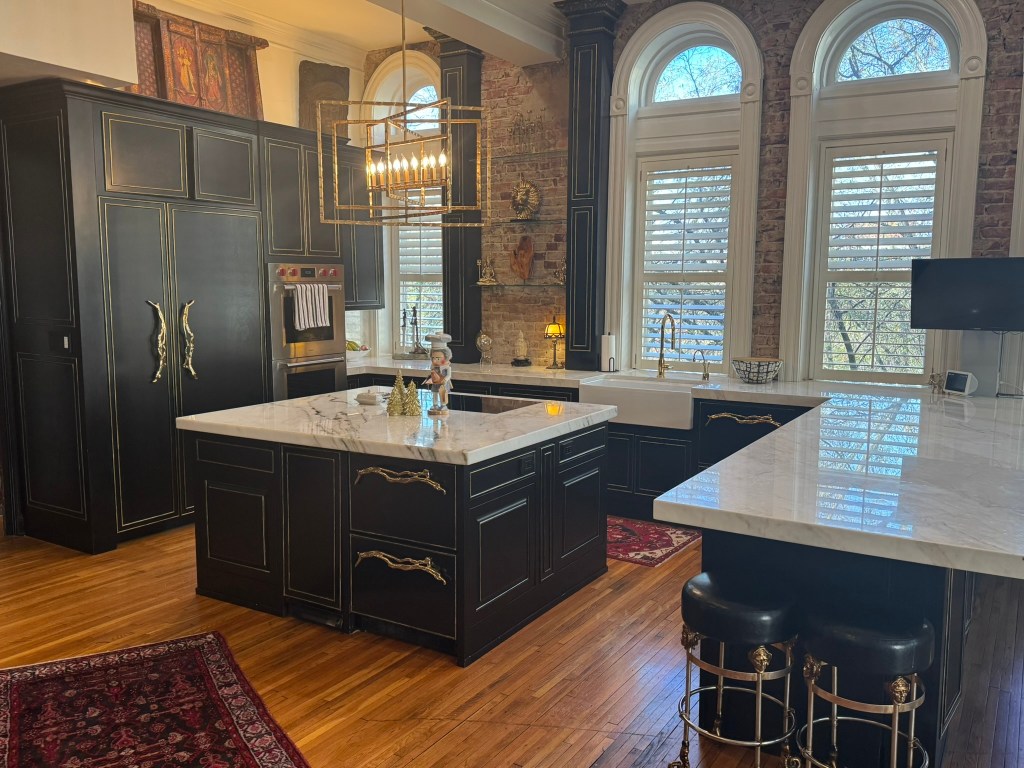
Cuisine américaine
A traditional or cozy kitchen style that gives into another living space. Features a large island and/or bar seating. (photo below)
Dépôt de garantie
Down payment
DPE (Diagnostic de Performance Énergétique)
Energy Performance Certificate (mandatory for property sales or rentals; rates the property’s energy efficiency from A to G)
Dressing
Walk-in closet
Écusson
signifies an area, usually snail-shaped, which was the old city center and filled with pedestrian cobblestone streets. Houses/apartments tend to have ancient stone walls, arches, and wood beams that might date to the medieval ages.
Enchères
Auction
État des lieux
A site-visit. The (real) estate agency charges a small, flat fee to do an inventory of fixtures and run-through the entire property to assess its condition. (First, when you move-in and again when you move-out.)
F1/P1
Same meaning for F or P; it denotes the number of rooms, not counting: bathrooms, laundry closets, screened-in porches, kitchens, mezzanines, etc. Usually composed of: living rooms/dens, bedrooms/guest rooms.
FAI
Frais d’agence inclus dans le prix. No extra fee to a realtor; price includes the fee.
Garant
Guarantor (someone who guarantees rent payment if the tenant cannot)
Honoraires
Agency fees (often paid by the seller). Required to be listed on the front page of the agent’s website.
L’eau grise
Sink, shower, washing machine, dishwasher water
Locataire
Tenant
L’orientation de l’appartement
The main direction the property is facing. (North, South,etc.)
Loyer
Rent
Mandat
Exclusive or non-exclusive contract to sell or rent a property.
Meublé
Furnished (property comes with furniture)
Non-meublé
Unfurnished (property does not include furniture)
Frais de notaire
The notary’s fee to officiate the signing of the final deed and read it to you will always be a percentage of the sale price ~ 7% or 8%. For drafting the compromis/ preliminary agreement ~EUR 500.
PaP
Particulier à particulier; for sale by owner.
Pallier
Landing
Petit débarras or un cagibi (pronounced KGB)
Broom closet
Piscine/jardin piscinable
Swimming pool. A swimming pool can be built in the existing garden. In France, a pool costs around EUR 35 000 to build.
Pool house
Pool house
Préavis
A notice which says to your landlord you’re moving out. 1 month before you plan to move out.
Propriétaire
Homeowner
Quittance de loyer
Rent invoice
Rénové
Renovated (property has been updated or modernized)
Expropriation
Eminent domain
Surface habitable
Living area (total floor space available for living, excluding walls, staircases, etc)
Tantième
Share of co-ownership (applies to apartments in co-owned buildings; determines voting rights and share of common charges)
Taxe d’habitation
Residence tax (previously paid by occupants, but being phased out for primary residences)
Taxe foncière
Property tax (paid annually by the property owner). For 100 m2 in Nîmes in 2025 ~ EUR 1 350 per year.
Un quartier très recherché
A sought-after neighborhood. In Nîmes, it would be the expensive neighborhoods like where La Maison Carrée is situated in Les Jardins de la Fontaine/Écusson neighborhood, think beautiful surroundings with ample green spaces.
Viager
Life annuity sale (buyer pays a lump sum + regular payments until the seller’s death).
I hear plenty of horror stories from Facebook, news articles or from youtubers of foreigners who weren’t able to crack the code. Whether it’s purchasing a little chateau, farmhouse in Dordogne, or a Hausmannian building, this guide will bring you closer to your goal of starting your new chapter abroad. In it, I’ll tell you how the French buy a house. For a summary skip here.
*Disclaimer, this blog post is updated as of January 2026.* The post assumes that you have lived in France for over a year, hence paid taxes in France.
Step 1: The Property Search, tips for scouting, & how agents operate
Plan as much as you can in advance, the housing market (as I write this) is not in the best shape and most houses will still be available when you arrive for your scouting trip. Also, learn as much history of the city as you can while also familiarizing yourself with the surrounding areas. Lastly, keep in mind each city has a website, and if you have any questions you can always contact us.
If your French isn’t top notch, I’d recommend, if possible, to find a chasseur immobilier (personalized property searcher) that speaks your language. We not only help you find listings, most importantly we foresee problems to make sure the deal happens. On top of that, we negotiate the price and serve as an interlocutor. And hiring us is simple. We draft a mandat de recherche. It’s a short document that says if we introduce you to the property, then we’re due a commission. Usually there is no additional fee as the commission is shared between the listing agent and the chasseur, but be wary some agencies might tack one on.
I’m here to provide this service and want you to feel safe with what is a major life decision. I’m someone who has made the move so I know how to manage the speed bumps along the way. When going from one language to another. Things will be lost in translation. A main pillar of doing the deal is a clear communication channel, so here are some terms used in l’immobilier that you will find useful.
Some things to point out: the (real) estate agents in France are generally paid by the seller as they are the ones who hire them. For the buyer, from the point the offer is accepted, your notaire will enter to draft the preliminary contract (compromis de vente). One of the reasons buyer’s agents aren’t as common is because the notaire will insure the deal is done in good faith and is an added protection for the buyer for an additional fee. Some agencies are able to draft them, but most delegate this part of the process to the notaire chosen by the buyer.
Going about it the French way/on your own makes it so you’re not tied to one agent. With translation apps and AI it makes it very possible to proceed without a chasseur immobilier, just make a prompt in your favorite AI along the lines of “les differences entre un achat immobilier en France par rapport aux USA“.
Frankly, agents are not a necessity (only 60% of deals are done with us ;))
You have access to (practically) all the listings online for free in France (here are mine). There isn’t a multiple listing service for agents. We sign a listing agreement (most of the time non-exclusive). It includes all the details of the house, including price and commission, etc. Then we post the info on sites most commonly used for finding properties like Le Bon Coin and Bienici. The equivalent in the US is Zillow, StreetEasy, etc. and Zoopla in London, 591 in Taiwan, etc. After publishing the listing, we receive messages directly from the potential buyer.
When you find your future home, verify a DPE has been conducted, termite diagnostic and asbestos too. Usually, they do the DPE before putting it on the market. As of 2021 it has been preordained that ads publish the score as it is illegal to let (be a landlord) a flat with a failing one. For example at the time of writing this post the lowest allowed is D, but remember that’s just concerning landlords.
Step 2: Visiting a Property – make a checklist
You have narrowed it down and have a list of viable properties that you unearthed from one of the major real estate sites in France (or found by your chasseur immobilier).
I suggest making a checklist and noting down the pros and cons during the visit, so that when you think it over, you won’t need to rely on memory. Be wary of the agent’s time. In France, you shouldn’t request more than 2-3 showings. Also with the notes, you can easily compare it with the other showings.
The second visit is normally done with an artisan(remodel expert) to see what work is to be involved and at what cost. Then you make an offer accordingly. EUR 10 000 – 20 000 less is a good rule of thumb.
Once you come to an agreement, you sign an offre ferme or a formal offer. It serves as a predecessor to the compromis de vente. It secures your agreement for a limited time (1 week) until you get in touch with your notaire.
Step 3: The notaire/compromis de vente (preliminary contract)
It is common for both buyer and seller to use the same notaire who may insist that you hire an interpreter, if they feel your French isn’t good enough as they have a legal duty to ensure that you know what you are signing. (long sentence, sorry)
Finding a notaire in my experience isn’t hard. If you don’t already have one in mind, then ask the seller for theirs. When they purchased the house they also needed one. You can ask them to put you in contact, so it’s more smooth. It is commonplace. Otherwise, you can ask/call around. I’ve noticed their buildings are blazened with a gold sign outside their office like this one (see below).
Plaque de notaire
They will request a slew of documents called a dossier de vente which will include the DPE (diagnostic performance énergétique). It’s essential to get eyes on this before getting too excited about the deal. The DPE grades your house based on its consumption of gas and electricity in relation to others in terms of efficiency. It will also give insight on the costs associated with heating/lighting up your future home. And remember, the grade of your house needs to be at least an E if you ever wish to rent it. If this looks good, then congratulations! You are through the hard part and ready to request an appointment to sign a preliminary contract.
The Rendez Vous Chez Le Notaire
It will take a little over an hour, longer if you are someone who likes to flip over every stone. At the end of this meeting, you will be charged a small fee, ~ EUR 500, payable by card. Afterwards, the notaire will explain to you your next steps. Deals will differ in this regard so listen up! My deal was contingent on a loan offer, so the down payment which is called la versement du dépôt de garantie, was to be posted at the time they received the offer. The buyers received it within 12 days and put 5% down. The amount shouldn’t matter, but I wouldn’t post less than 5-10%. Had they been denied the loan, they would’ve been given 2 months to find another bank. If you’re paying cash, then your deposit should be wired upon signing the preliminary contract.
Afer the meeting, a 10-day cooling-off period kicks off (your final chance to withdraw from the deal without penalty). The next step is you wait and see. Mainly, for the notaire to confirm there aren’t plans for the city to invoke eminent domain. In total, from the first to the second/last appointment, we waited 10 weeks! Note: the deal happened in the summer. Average wait times are around 8 weeks.
Step 4: Sign the acte de vente/l’acte authentique or Final Deed
The day starts off with the visite contradictoire at the property to make sure everything is in order (i.e. the seller has moved out and/or the furniture you requested remains). During this visit, it is necessary to record the gas and electricity meter at the time of ownership change.
Now onto the appointment, much of what is in the acte authentique or final deed was already discussed/agreed upon when signing the preliminary contract. The delay between the two appointments seem to be for moving, financing, and the dreaded possibility of eminent domain. The city has a month to decide to purchase the property voiding the sale. Finally, the handing over of keys is done and the payment of arrears (la taxe foncière1) will be calculated by the notaire.
Takeaways
Looking back, the deal was unofficially “a done deal” following the preliminary contract, we met at the house with a bottle of rosé and there wasn’t anything to deter the buyer or seller from withdrawing. You could feel it, it was beautiful and the wine was delicious.
The whole buying process usually takes around 3 months from when you first visit the house to when you get the keys. Our deal took 3 and a half.
If you need housing for the short-term I’d advise to use services like Airbnb, VRBO, Booking.com.
Purchasing a property can be straight forward. A mix of frustration and lack of professionalism can screech a deal to a halt, but I’m here to reassure you that it takes time. Some nuances don’t exist anywhere but here. My style is to always stay positive and work with what we know. In turn, making sure that your deal has the highest chance of closing and uncorking a bottle of rosé.
Passez une belle journée,
Chandler BELL
Real Estate Agent
chandler@lesterrassesimmobilier.fr
+1 423 488 1063
+33 7 89 05 64 06
RECAP
The Timeline of Buying a House in France in 2026
1️⃣ Property Search & Offer (1–… months)
Find a property, visit, and negotiate the price. Sign a compromis de vente (preliminary contract) with a 10-day cooling-off period.
2️⃣ Cooling-Off Period (10 days)
Buyer can withdraw without penalty within 10 days of signing the compromis. Buyer typically pays a deposit (dépôt de garantie, usually 5–10%) upon signing the compromis, held in escrow by the notaire.
3️⃣ Mortgage Application (1–2 months)
Apply for a mortgage (if needed) and receive a binding offer from the bank. Buyer has a 10-day reflection period before accepting the mortgage.
4️⃣ Notaire Due Diligence (1–2 months)
Notaire checks property title, liens, and legal status, including any risk of eminent domain (expropriation for public use) or local preemption rights. Seller provides required diagnostics (DPE, termites, asbestos, etc.).
5️⃣ Signing the Acte Authentique (Final Deed)
Buyer and seller sign the final deed at the notaire’s office. Buyer pays remaining funds (including notaires fees and taxes).
6️⃣ Keys Handover & Move-In
Buyer receives the keys immediately after signing. Property is officially transferred, and buyer can move in!
⏳ Total Time: ~3–6 months (Can be faster for cash buyers or slower if financing/legal issues arise.)
Note on Eminent Domain in France:
Called expropriation pour utilité publique, it allows the government to take private property for public projects (e.g., roads, schools). The notaire will check if the property is subject to any planned expropriation during due diligence.
La taxe foncière or Tax Foncier is the equivalent of UK rates and is paid annually in arrears by the owner of the property on 1 Jan, ↩︎
Okay, so you’ve got your new French bank account and you’ve successfully transferred some of your dollars to euros. Time to celebrate—grab a drink, you deserve it!
Are you ready to find an apartment? The easiest way to find one in France, a country where the people tend to veer towards the low-tech side of things, is through word of mouth, ads at a bakery, etc.. Seriously, you should try it. Don’t be shy. People in the South are often more than willing to help you. I’d put them up against your run-of-the-mill real estate agency any day. That said, most random people will just point you towards the nearest immobilier agency/realtor but who knows you might just find a landlord within arm’s reach.
NETWORKING
Make a connection then you don’t need to worry. This would be an atout if you pull this off. If you are more internet savvy I recommend using PAP.fr as a starting place. PAP (or particulier à particulier) is the English equivalent of for sale by owner, but here in France it is used for rentals as well as sales. You’ll have direct access to hungry landlords who are searching for tenants for their apartments. I believe this is the quickest surest solution to what can be a David & Goliath battle. Plus, it would serve as an auspicious start for your new chapter abroad.
Going about it on your own
While you’re in this pre-search/search mode of your journey – it’s tempting to use this as a way to voyage through listings. Sorry to burst your bubble but you have no idea if these same listings are available to you. The elephant in the room is the infamous French landlord. Before determining viability or vibe-ability, will the owner even consider renting to a non-French person? The answer is likely not the one you want, Why? It’s fairly simple – the laws. I find France like New York in the sense that housing is regulated and most laws are slanted to help tenants.
Always remember too that you’re competing with the French renters/buyers, and to save you some time, try not be too picky when you start your search. If you can, up your budget a bit, settle for funky over new and sleek, next thing you know, voilà! a first flat with an interested landlord.
The dossierstandard for them includes : a contrat de travail (salaried worker contract, seasonal work, etc.), 3 recent pay stubs, last year’s taxes, and ID. The work contract is an essentiel layer of protection and it’s non-negotiable for lots of landlords. If you don’t have one of these 4 documents, it’s going to be a struggle competing with the field of prospective tenants.
I’ve learned working in sales at the end of the day everything is a numbers game. Think of the landlords as buyers and you are a stock. They would like the most information possible before investing in you. What speaks to them are the documents they are familiar with. I thought the number in my BoA account would hold more value. I was mistaken. It helped, but with my landlord, he wanted something that said I was here to work, simple as that.
Feel free to contact me, if you are unsure what to submit, and I’ll look it over with you. I specialize in selling but I’ve also been in your situation and am willing to do what I can.
I know what you’re thinking – isn’t there a shortcut to finding landlords who rent to expats/immigrants (a sort of green book for foreigners would be useful, huh?)
It is an idea that is worth pursuing. But for now, if you’re still looking for answers then I’m here to help as I have experienced the struggle of finding a place as a foreigner. It’s one of the reasons I changed careers from commercial to residential real estate – to help others in need.
Follow my blog to receive more info from an American licensed to sell/rent/manage French real estate. Our business ushers an international clientele to the door to their next Home Sweet Home in the south of France. Also, I’m constantly uncovering properties.
If you don’t see a listing that interests you, please let me know where you would like to be and I’d love to help you personally or by connecting you with a specialist in the area.





 Les Terrasses Immobilier